

A journey to the Moravian Churches in India, 8th-16th April 2026 – Part 1
Almost six years ago, on 30th June 2020, Br Joachim Kreusel (Ockbrook) and I (then in Berlin) set up an online study group. Br Joachim had this idea after a trip we were both planning to India had to be cancelled due to the COVID pandemic. We then began meeting regularly via Zoom with young theologians from the Moravian Church in India and Myanmar to discuss key principles of the Moravian faith. The group grew, and so Brothers and Sisters from Nepal, the United Kingdom, Germany, and even Tanzania joined in.
I learnt a great deal about life in the communities, about their families, their own traditions, their questions, successes and concerns. Unfortunately, there is very little coverage in our media in Germany of the situation facing Christians in India, Nepal and Myanmar.
One question occasionally crossed my mind: would I ever be able to visit the brothers and sisters there in person? At the start of the year, I received a surprise phone call from Br Joachim asking if I would accompany him on a visit to India in April. Of course, I said yes. We got in touch with the brothers and sisters in India, booked the flights and applied for the visa.
On the night of 8th-9th April, we arrived at Delhi Airport, having travelled from London and Munich. Given the war in Iran, we were glad to have direct flights. We were warmly welcomed by Br Levi and Br Ebenezer. Both are pastors at the church in Delhi. They arranged excellent accommodation for us in a guesthouse not too far from the house where the two families live.
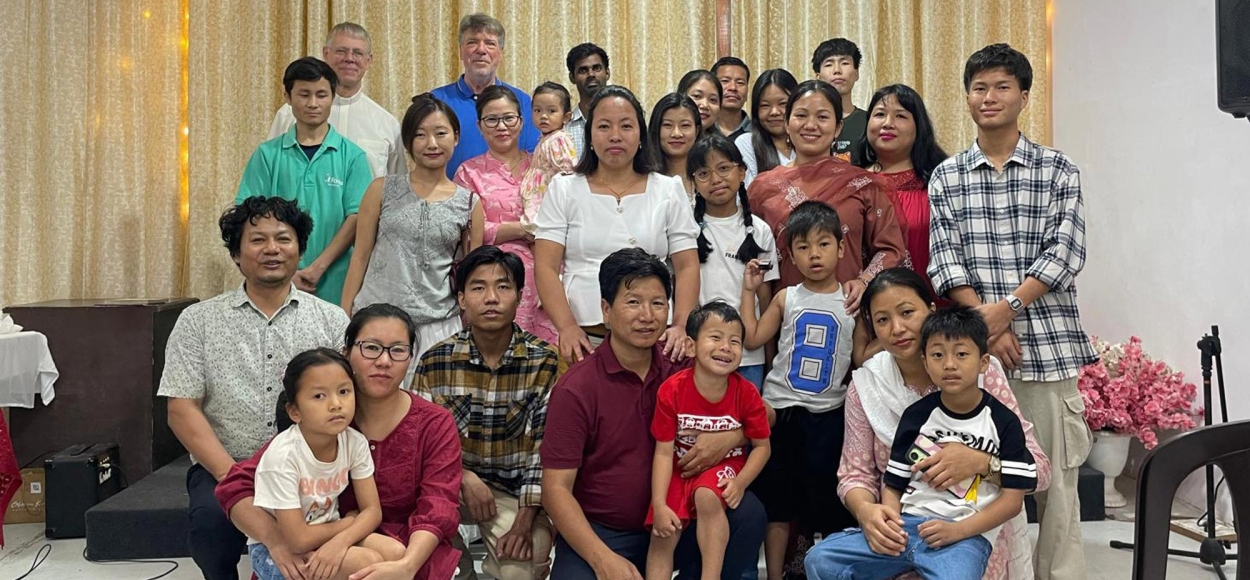
We were able to spend a few days with the brothers and sisters in Delhi. We enjoyed the sightseeing and being invited into the families’ homes. The city, with its crowds of people and the loud, fast-moving traffic, was a bit of a culture shock for me. On Sunday, 12th April, we attended the service. It was a lovely and lively service attended by around 25 people, including many young people. We were picked up and driven to the hall at the Young Christian Academy in Munirka Village. A narrow side street winds its way between tall buildings to a basement entrance. That is where the simple churchroom is located. The Moravian Church rents the room for two hours for the services. To set the mood, there was plenty of singing, in both Hindi and English. Two young women led the music with guitar and vocals, accompanied by a cajón. Readings, songs and prayers followed a set order of service. Two children read the Bible passage in English. We gave welcoming words of greetings, assisted with Holy Communion and the final blessing. It was checked whether a translation was needed. Apparently, everyone understood English. At the back of the room, there was a Sunday school. Before everyone went their separate ways, a group photo was taken. Most of the visitors, however, met up afterwards in a park to enjoy a picnic together. We sat on blankets in the shade of the large trees and ate the food some of them had brought along. Brr Ebenezer kept a stick handy, because a monkey came over to take an envious look.
On Monday, we travelled via Kolkata and Silchar to Binnakandi in Assam. Compared to Delhi, we found ourselves in a completely different world. We were warmly welcomed at the small airport by Br Nathaniel and others. An hour-long drive took us past tea plantations along roads where cows, sheep, chickens and dogs have right of way. At the church in Binnakandi, we were welcomed by the elders and a number of congregation members, and we felt as though we had come home. We were comfortably accommodated in the building right next to the church and were served wonderful food, freshly prepared by a team of cooks from the congregation. I will always remember the laughter of the sisters as they worked in the small kitchen. Right at the entrance to the church grounds lies the grave of Br Kagauchung Rongmei Nage, who was known simply as Br Kabui. He died six years ago and can be regarded as the founder of the Moravian Church in North-East India. His fascinating life story is well worth reading.
On Tuesday morning, we had a meeting with the team from the Moravian Institute in Binnakandi. It was still the school holidays there, and school was not due to start again until the following Monday. The school has very dedicated teachers. 83 children are currently enrolled. A key focus is on helping children who would otherwise receive little or no education. These include, among others, the children of workers on the tea plantations. Yet the challenges are considerable. The upper floor needs to be demolished. Termites and the hot, humid climate have taken their toll on the wooden structure. The damage was clearly visible. Ideally, a completely new school would need to be built, but as there isn’t even enough money to demolish the upper floor, that is a pipe dream at the moment. An even greater long-term challenge is securing the school’s overall financial future. This primarily concerns the salaries of the eight staff members. Until now, the school had been a branch of the Moravian Institute in Rajpur. Following a decision by the board in Rajpur, it has now been granted independence.
In the afternoon, we visited ‘Binnakandi Rongmei Nam’, where most of the congregation members live. This settlement is like a village for members of the Rongmei tribe and is situated just across the road from the church and school grounds. Christians and people who follow the traditional folk religion live side by side. This sometimes leads to tensions.
I was particularly impressed that evening by our visit to a church member’s home for a prayer meeting, a ‘cottage prayer meeting’. We sang and gathered up prayer requests. This was followed by a ‘mass prayer’, a time of communal prayer during which everyone could bring their requests before God aloud, together with the others.
On Wednesday and Thursday we were able to visit the congregation in Haflong. This is situated in the mountains of Assam. Construction of a new road is now progressing, so that Br Joachim, who had packed travel sickness tablets in memory of his previous bad experiences, was quite pleased. The climate in Haflong is somewhat more pleasant compared to Binnakandi. However, landslides repeatedly cause a great deal of damage there. The church had to be rebuilt a few years ago. Life is simple but warm-hearted. In a house not far from the church, we met with members of the congregation, including an evangelist. We were also able to stop by the home of Sr Suaihiamlu and Br Jacob who are both Moravian ministers. Sr Suaihiamlu is the first ordained female minister in the Moravian Church in India. It was lovely that we were able to hold a spontaneous gathering in the church with singing, a scripture reading and prayer. The church has been restored to its former beauty, though concerns remain as to whether its foundations will hold on the slope.
During a walk, we were able to view the plot of land that the congregation had purchased a few years ago. In the long term, there are plans to build a small school. However, it is unclear when construction can begin. Generally speaking – and not just in Haflong – receiving external support is not straightforward, as the Moravian Church in the Northeast does not have a bank account into which foreign currency can be paid.
Br Erdmann Becker
Retired Pastor, Kelheim, Bavaria
To be continued next month ...
More Spotlight News
The American Revolution and the Moravian Church
A journey to the Moravian Churches in India
