

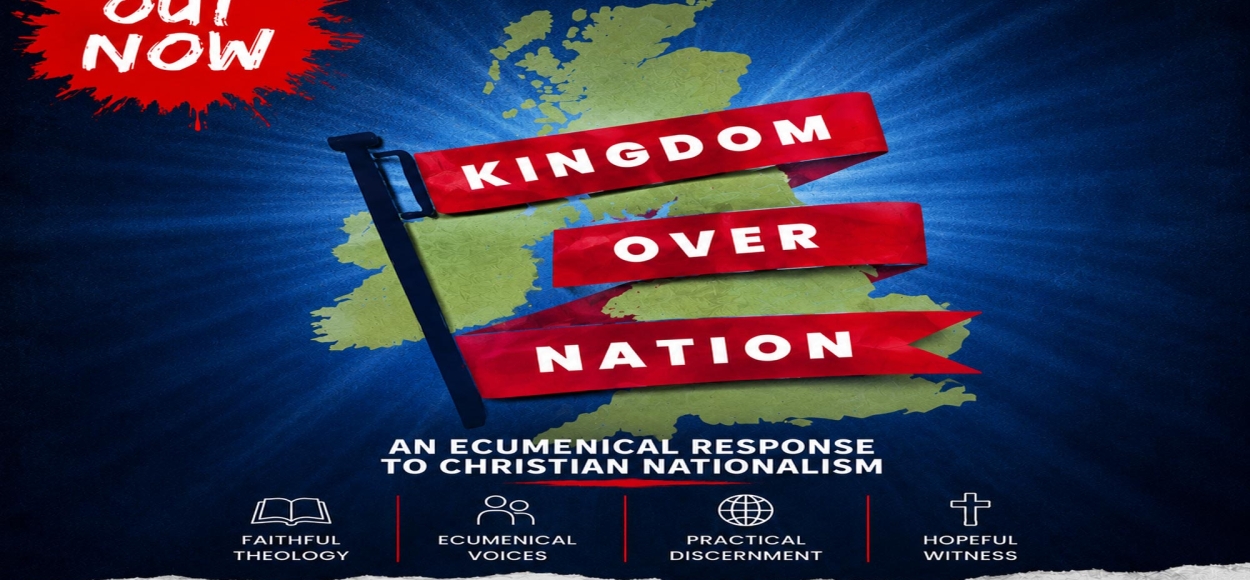
Kingdom Over Nation
In recent months, we have seen a noticeable rise in voices that seek to align Christian faith closely with national identity. At times, Christian language and symbols have been drawn into wider cultural and political conversations in ways that can feel both powerful and deeply uneasy. Into this context, a statement from the Presidents of Churches Together in England (CTE), issued in September, speaks with clarity and care. It reminds us that the cross of Christ can never be used to justify hostility, exclusion, or a sense of superiority over others.
As Moravians, we often find ourselves returning to our own story for guidance and inspiration. This month includes the Memorial Day for the founding of Herrnhut. On 17th June 1722, when Christian David cut down the first tree, it was not simply the beginning of a settlement, but also of a community formed by those who had fled persecution: refugees who carried with them the faith and practices of the Unitas Fratrum. They came not to assert a national identity, but to seek a place where they might live faithfully under Christ.
Under the care of Count Zinzendorf, Herrnhut became more than a place of refuge. It became a community in which identity was reordered around Christ himself, so that people of different backgrounds and traditions were gathered not around a shared nationality, but around a shared Saviour. Even the name ‘Herrnhut’, the Lord’s watch, speaks of a people attentive to Christ and held in his keeping.
That is not to suggest that life together was simple. The disputes of the mid-1720s remind us how easily difference can lead to division. Yet the renewal of 1727, often called the Moravian Pentecost, came not through uniformity but through a rediscovery of love, expressed in a simple phrase: ‘we learned to love one another’. From this flowed a missionary movement that crossed cultures, languages, and nations.
There is, perhaps, an important question for us here: if our origins are found in a community of refugees, gathered across difference and renewed in love, how do we understand our identity today? And how do we respond when the language of faith is used in ways that seem to narrow, rather than widen, the embrace of the gospel?
The statement from the Presidents of CTE draws us back to Scripture: to the call of Leviticus to love the stranger, and to the words of Jesus in Matthew 25, where welcoming the stranger is bound up with welcoming Christ himself. These are not peripheral texts, but central to a biblical vision of community.
It is encouraging, therefore, that Churches Together in England are preparing a new resource, Kingdom Over Nation. It aims to encourage theological reflection on nationhood, identity, belonging, and the Kingdom of God, and to provide space for churches to discuss the tensions around nationalism that may be present within congregations. Drawing on contributors from across the Christian traditions, it is intended to be engaged with, shared widely, and responded to, so that churches might reflect together with greater clarity and care.
As we approach the Memorial Day for the founding of Herrnhut, we might see this anniversary as an invitation not simply to look back with gratitude, but to look around – and within – with honesty and hope. We can ask what it means, in our time, to be a people whose primary belonging is in the Kingdom of God, and how our life together might bear witness to a love that crosses boundaries rather than reinforces them.
Br Michael Newman
Minister of Hornsey and Fetter Lane Moravian Congregations
Kingdom Over Nation can be obtained from: https://cte.org.uk/working-together/kingdom-over-nation/
More Spotlight News
The American Revolution and the Moravian Church
A journey to the Moravian Churches in India
